Terence Tao's Blog Asks "Why Are We Even Doing All This?": What Mathematics Is For Once AI Can Solve the Problems
On October 15, Terence Tao’s blog, What’s new, ran a guest post titled “Why are we even doing all this?”. The author is the theoretical particle physicist Rikab Gambhir, and Tao added a one-line editor’s note at the top.[1] Tao says he is mostly handing the blog to guest authors for now,[18] and his own views have appeared on Mathstodon. So the post is best read next to his threads from the past six weeks: the guest post asks the question in its most uncomfortable form, and Tao supplies an answer you could use to rewrite how the field evaluates people.
The same day, Derek Thompson published “I Know Why the Mathematicians Weep”, and the Hacker News thread on it stood at 391 points and 669 comments as of October 18.[2][5] The Simons Foundation announced that it, Anthropic and OpenAI would put USD 15 million into helping mathematicians adapt to AI.[3] In the same week, 35 authors posted TheoPhysEval on arXiv: 50 unpublished, research-level theoretical physics problems, of which the best agent solved 49.[4]
The previous post on this site, What a Passing Lean Proof Actually Verifies, asked how much of “AI proved X” a machine has really checked. This one goes further: even if every result is correct, why should mathematicians still do mathematics, and how should the profession and its institutions adjust? My answer: AI has broken the line “we solve hard problems”; what still holds is “we produce understanding, and train the people who carry it”. I’ll argue it in three layers: capability, meaning and institutions.
What AI can do now: TheoPhysEval measures “turn-the-crank” work
TheoPhysEval collected problems from experts, ending up with 11 themes, under three requirements: tied to current research, easy to verify but hard to guess, and not findable in the literature. The paper calls them “turn-the-crank” problems: they push an existing result one step with known techniques, so the answer is new and sometimes publishable, but not groundbreaking.[4] A typical one changes a few parameters in a calculation from the contributor’s recent paper, so anyone else must find that paper, understand it, rebuild the calculation and redo it. For the “Page time of a black string” problem, Suvrat Raju, a co-author of the underlying paper, took about a day to adapt it; before modern agents only a handful of experts could have done it, in several days.[4]
To avoid an LLM judge, every symbolic answer was turned into a number by assigning values to all quantities, and only floats were compared. A “realistic” track allows web search and local tools; an “isolated” track has no web. Each problem gets 2 vCPUs and 4GB of RAM, anything without an answer after 8 hours scores zero, and each agent runs once.[4]
On the realistic track, GPT-6-Astra in Codex solved 49 of 50, Opus 5.5 in Claude Code 46, Gemini 3.8 Flash in Antigravity 34, DeepSeek-V4.1-Flash in Codex 27 and GLM 5.3 in Claude Code 21. Offline, Astra and Opus both scored 46, Gemini 31, GLM 26, DeepSeek 25. Astra’s API bill for all 50 realistic-track problems was USD 116.28, under USD 3 per problem.[4] Two details say more than the totals. Several problems Astra was first marked wrong on turned out to have errors in the experts’ reference answers. And accuracy barely dropped offline, though some problems use notation a human could not parse without the background paper; the authors conclude frontier models have memorized much of the theoretical physics literature.[4]
Figure: how TheoPhysEval sources and scores problems, and how many each of five agents solved on both tracks. Data from[4].
Only one problem beat every model: recovering the autonomous differential equation behind a given curve.[4] More important is the line the paper draws around its own result. Concrete calculations often come late in research, and in the authors’ experience agents are bad at swapping an overly hard problem for a simpler but equally interesting one. They also lack a physicist’s taste for what is interesting, and when asked for new problems they fixate on dull details. The authors quote the old line “shut up and calculate” and suggest physicists may now need to “stop and think”.[4]
Mathematics is similar: OpenAI said each result in its October 6 release used on average about three hours’ worth of ChatGPT Pro thinking.[16] Anthropic’s October 16 post is another kind of example: an internal model took under half an hour to trace the seeds of five NIST curves, P-192 through P-521, to the C library’s lrand48 generator seeded with Unix timestamps from 1997 and 1998.[15] A question that bothered cryptographers for over twenty years turned out to be “just timestamps”, and nearly all its value is in the answer itself.
In short: once a problem is clearly stated and mechanically checkable, AI matches or beats top experts at a few dollars per problem. What it has not covered is everything before the problem exists: what to pick, how to switch when the pick was wrong, and what is worth computing.
The question a satire asks
Gambhir’s post is irony throughout. It opens with a riff on “First they came for…”, and when they come for the physicists, “it’s actually pretty cool, they gave me free tokens and promised to solve my entire field.” OpenAI, it says, has fulfilled every mathematician’s childhood dream: a cold corporate robot burning a rainforest to assemble 700 nearly unreadable, “maybe” true facts as a pre-IPO stunt.[1]
Under the irony the argument is specific. By 2026 standards, he says, Borges’s Library of Babel, holding every possible book, would be history’s most successful research institution. OpenAI’s “efficiency gain” is to generate only things that look right and outsource the unglamorous, unpaid job of checking and understanding them to the whole community, a job that used to belong to the paper’s authors.[1] Scientists used to be limited in how many problems they could solve by how many answers they could understand. That bottleneck is gone, and now “there is no theoretical upper limit to the number of scientific facts we don’t understand.”[1] The final line drops the irony: remember why you chose science and mathematics in the first place.
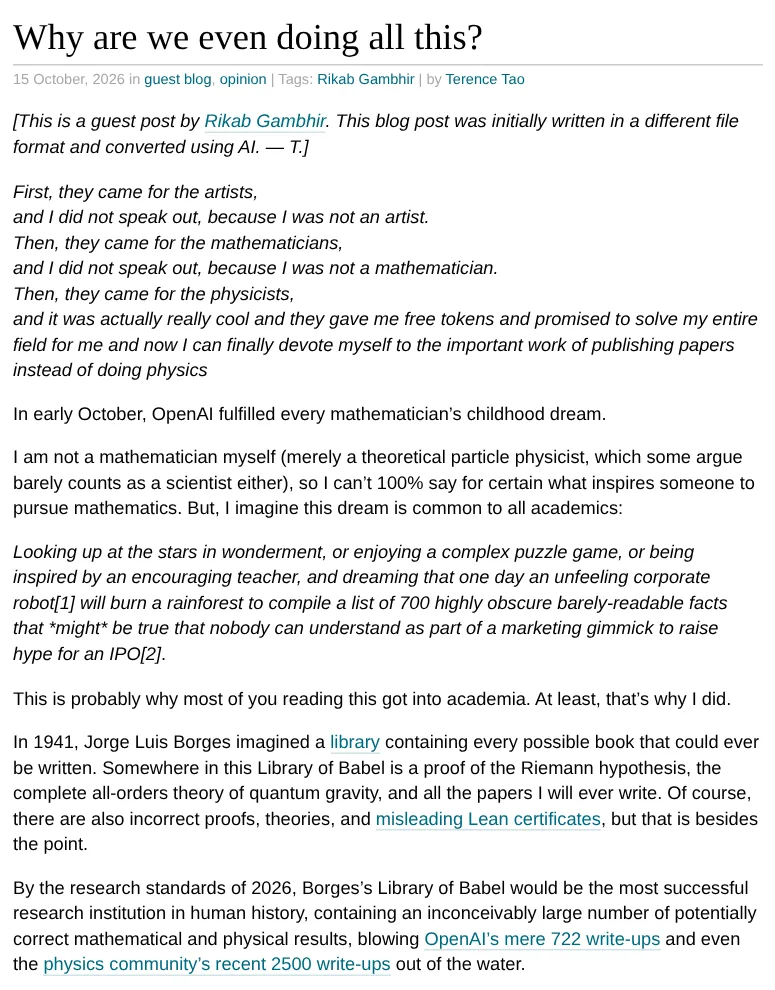
Screenshot: the guest post on Tao’s blog, with Tao’s editor’s note under the title; the text mentions OpenAI’s “mere 722 write-ups” (What’s new, captured Oct 2026)[1]
In the comments, a reader signing as BE raised the hardest question, “why should we be paid for this”, which the post never answers: if you want salary and status on top of enjoyment, you have to say what it is for.[1] Lior Silberman was practical: society pays him to prove theorems, so his enjoyment ranks below the social value of mathematics, and if theorem-proving stops being worth paying for, he needs other reasons, such as developing and spreading understanding and applying it outside mathematics.[1] mitchellporter rejected the premise: the write-ups are hard to read but substantive, and the real problem is that nobody knows how to fit non-human entities that do research-level mathematics on demand into existing practice.[1]
The satire answers “why do I do this”: curiosity, understanding and the joy of creation. It does not answer “why does society pay for it”, the professional question, and Tao’s recent writing is an answer to that.
Tao’s own answer: good problems are a resource that can be strip-mined
In early September Tao posted a thread on Mathstodon built around two questions: “What is the answer to X?” and “What can be learned from studying X?”. The second covers where the main difficulty lies, what new techniques are needed, why existing ones fall short, how X connects to other topics and what the natural follow-ups are. The two used to line up, because the only route to a hard answer ran through those sub-questions. When powerful AI tools are pointed at X without experts in the loop, they diverge and can become negatively correlated: optimizing for the answer yields fewer insights, because the answer contaminates later reasoning, lowers the signal-to-noise ratio and removes the incentive for further analysis.[7]
His example is the Equational Theories Project (ETP), which settled more than 22 million implications in universal algebra over a few months and formalized them in Lean. A few implications held the team up long enough to force new techniques for building infinite counterexamples; automated provers later found small finite counterexamples for them. Had the finite counterexamples come first, the more interesting methods might never have appeared. In his words, for the first time in the history of mathematics, open problems in pure mathematics are being mined like a non-renewable resource, and mining them crudely leaves mathematics with far less net gain.[8]
Open problems can be generated endlessly, the 10^10^10th digit of π for instance, so why are they scarce? Because most are not worth attention, and judging which are depends on knowing a field’s “difficulty landscape”: what is easy with known methods, what yields to effort, what is out of reach. AI flattens that landscape most of all, and since AI companies do not publish negative results, nobody knows where the boundary lies. What is scarce now is finding a good problem. Once word gets out that someone is working on one, a flood of compute may flatten it first, so people stop sharing promising directions.[9]
A September 10 thread is about how the profession presents itself. Many are drawn to mathematics because it lets them bring a child’s curiosity to serious work, but to satisfy the adults paying, mathematicians stress hard goals like “solve this open problem”. That polite fiction worked because human problem-solving used both the child’s skills and the adult’s. AI can aim straight at the nominal goal: “the flag is captured, the goal is scored, the problem is solved; at the expense of the lessons, insights, collaborations, and new goals that were supposed to be acquired along the way.”[11]
I think this is the key passage in the whole debate, because it answers BE. “We solve hard problems” was always half the story told to funders; the other half is the techniques, connections and people the process leaves behind. Once AI makes the first half cheap, the second has to be said out loud. Tao’s “Math 2.0” thread of October 7 does that. Math 1.0 prizes being first to solve an open problem, even if nobody understands the solution at first. Math 2.0 moves bare problem-solving out of the center, measures progress more broadly by raising the status of exposition, community building and new directions, and asks the community to rethink its standards for education, publication and promotion.[6]
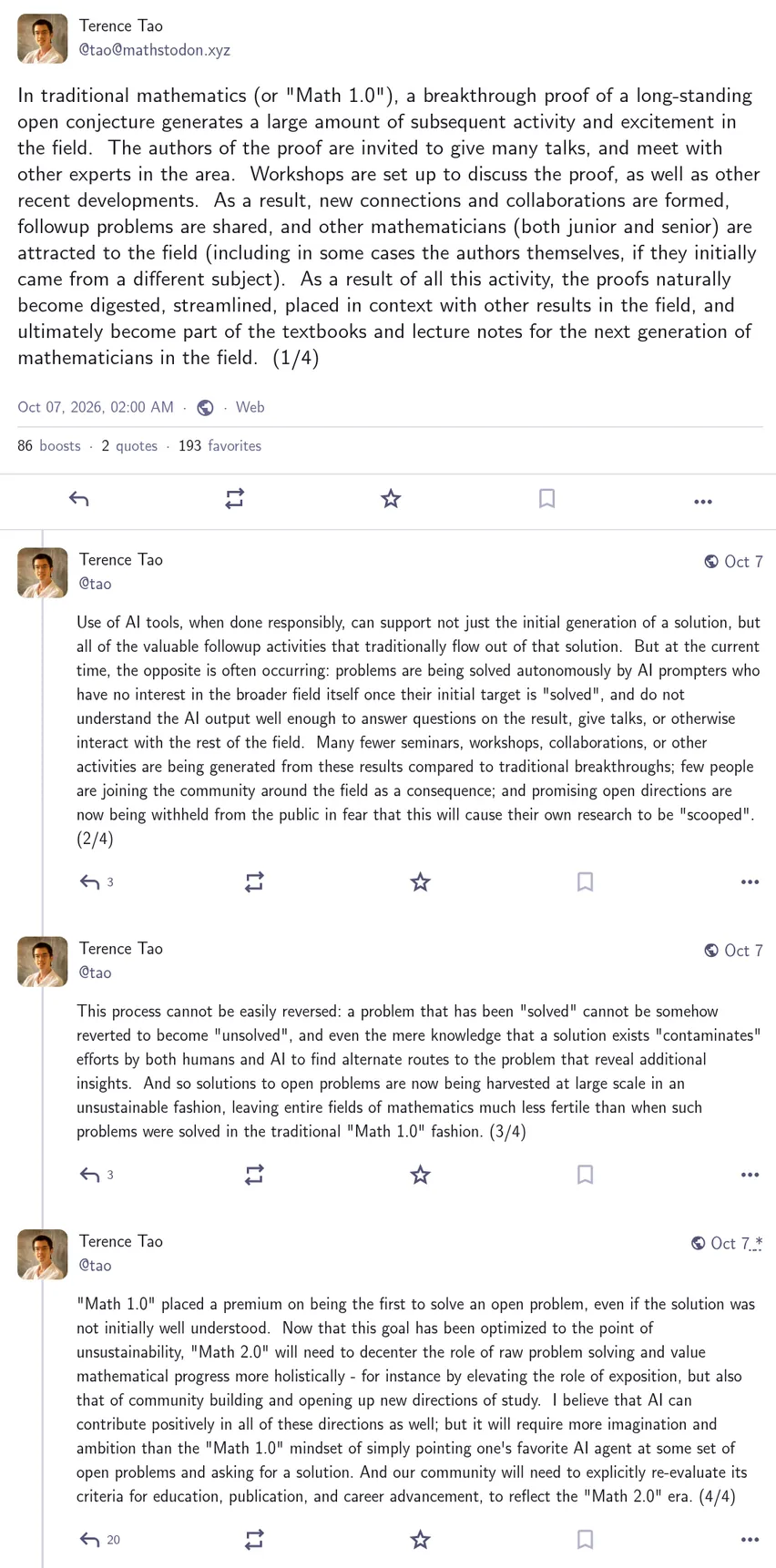
Screenshot: Tao’s four-post “Math 2.0” thread on Mathstodon, from how Math 1.0 breakthroughs get digested to why AI problem-solving leaves fields less fertile (Mathstodon, captured Oct 2026)[6]
He also sketched an alternate timeline for prime gaps: with benchmark-chasing AI companies in 2005, the bound would have stalled at three digits, the problem been declared “saturated”, the results left undigested, and the Maynard sieve, now a textbook method, perhaps never found. The bound itself has little intrinsic value, he stresses; the value is in what the research to improve it revealed.[10]
Thompson: the craft survives, the conversation breaks
Thompson’s essay opens with tears. Hugo Duminil-Copin, a 2022 Fields medalist, said after OpenAI’s October release: “I cried on Tuesday night and woke up my daughter. They’ve destroyed my field.” Cornell’s Steven Strogatz said colleagues talk of “strip-mining our discipline.”[2]
Thompson’s frame is that science is both a craft, a way of looking and asking, and a conversation; Newton’s “shoulders of giants” and Feynman’s “science is the belief in the ignorance of experts” are both about other discoverers. Strogatz told him about a line Archimedes wrote to Eratosthenes: there will be no shortage of discoverers to add new theorems to the ones allotted to us. Strogatz said he felt Archimedes was writing to him.[2] In Thompson’s reading, OpenAI ended hundreds of treasure hunts at once, a success on the craft axis that broke a millennia-old conversation. He closes with a question: what if OpenAI is right, and mathematics was mostly a treasure hunt all along, rather than a conversation in which feeling and discovery matter equally?[2]
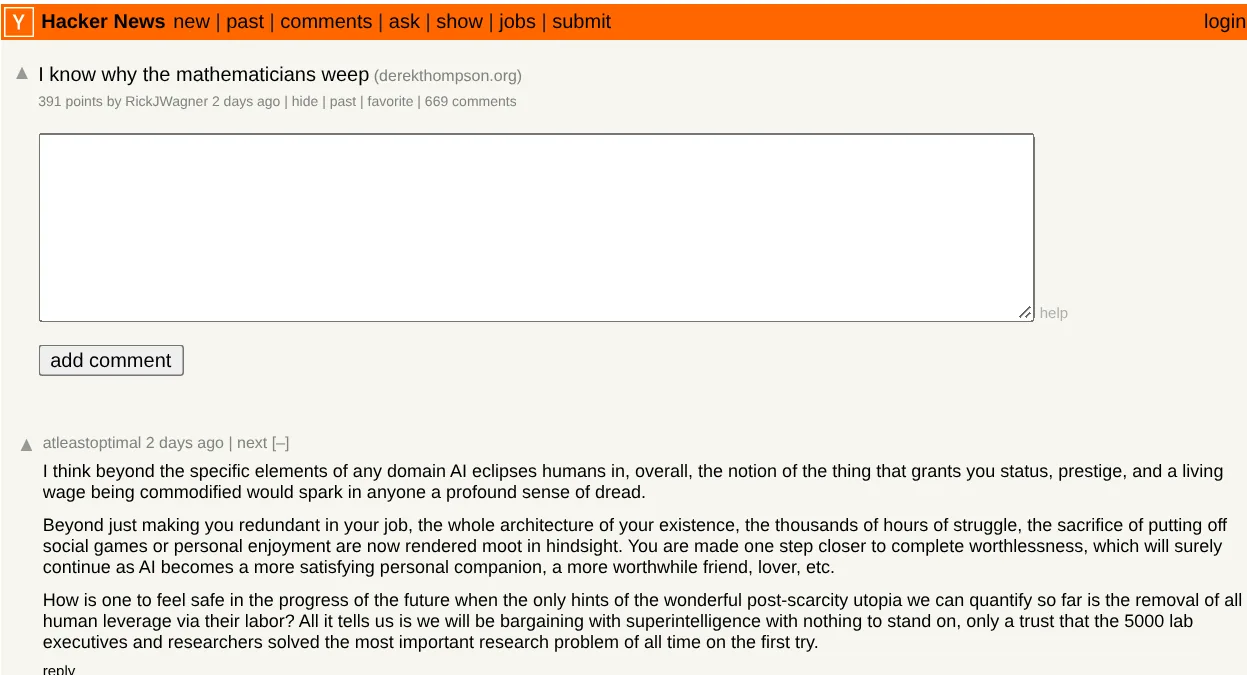
Screenshot: the Hacker News thread on Thompson’s essay and its top comment (HN, captured 2026-10-18)[5]
On HN the talk turned to labor. The top comment said anyone fears seeing the source of their status and income commoditized.[5] A software engineer found it hard to sympathize, since universities have not fired mathematicians; others noted that many mathematicians were already in precarious jobs or had moved into software and actuarial work, which are being automated too.[5]
Thompson picked the right word in “conversation”, but frames it too much as feeling. Tao’s account of Math 1.0 shows the conversation is how technique passes on: the talks, workshops and collaborations after a breakthrough are how a proof gets digested, simplified, placed in context and written into textbooks.[6] Break it and you lose the route by which new methods reach the textbooks. On labor, the TheoPhysEval authors are more concrete: newcomers are hit first. Such problems used to be good starter projects, building skill and yielding an original result; assigning them that way no longer makes sense unless everyone is clear the point is only to work through them.[4]
What institutions are doing: USD 15M buys “digestion”
The Simons Foundation says it, Anthropic and OpenAI are committing a combined USD 15 million in funding and resources, administered by the foundation with an open call for proposals, for workshops and projects that help researchers evaluate AI-assisted results, learn new tools and set standards for AI use; the companies will also give grantees tools and compute, extending to other basic sciences.[3] President David Spergel said mathematics is “not a collection of proofs and theorems but a collective understanding driven by human curiosity”, and that the community, not any one company or institution, should lead how these tools are evaluated and used.[3] The foundation also funded early work on the Lean proof assistant.[3]
Tao’s complaint was that AI results bring too few seminars, workshops and collaborations,[6] and this money pays for that digestion layer. With the other moves of recent weeks, institutional responses fall into four groups:
- Setting norms. The Advisory Group on Mathematics and Artificial Intelligence (AGMAI), hosted at the Institute for Advanced Study, has nine members, independent of AI companies, unpaid and advisory only.[20] On September 11, 25 Fields medalists (the page now lists 28) signed “A Severe Misalignment of AI in Mathematics”: problem-solving is a tool and proxy for conceptual understanding, and forgetting that lets the tool undermine the real goal.[13] The Association for Human Mathematics (AHM) went further and called on mathematicians to stop working with OpenAI.[19]
- Paying for digestion. Besides the Simons money, OpenAI said in its October 6 release that it would fund workshops, conferences and programs around understanding AI results.[16]
- Building their own tools. SAIR Open Math OS, which Tao is involved in, soft-launched on October 16, hosting open models such as DeepSeek V4.1 Flash (about a year behind the frontier, he says) around team accounts where members see each other’s prompts.[17]
- Recording human contributions. Deanna Needell and Hayden Schaeffer are collecting stories on Tao’s blog about what mathematicians did in this wave of AI preprints: early results, checking arguments, connecting to the literature.[21]
Figure: what each layer (capability, meaning, institutions) already has and what is still missing. Sources:[1][3][6][13][15][17][20].
My view of the money has two halves. The direction is right: it pays for the job Gambhir says was outsourced.[1] But the two companies paying made digestion expensive in the first place. Sophie Huiberts wrote on Tao’s blog that proving a theorem means taking responsibility toward your field, at minimum saying which steps are new ideas; OpenAI instead split 372 results into 719 PDFs without proper attribution, PDFs she called the “exhaust” of internal benchmarking.[14] Whether that is fair was hotly argued, but generating and digesting results are now clearly separate jobs. USD 15 million funds many workshops but cannot touch the last item on Tao’s list, standards for education, publication and promotion;[6] only departments, journals and funders can change those.
Then there is fairness: the TheoPhysEval authors worry that theoretical physics, long cheap and egalitarian, will need more resources for harder problems.[4] Their own data measures the gap: DeepSeek-V4.1-Flash, which SAIR hosts, solved 27 of 50 on the realistic track, against Astra’s 49.[4][17] Community tools solve collaboration problems, but for now they do not close the capability gap.
My view: which work gets diluted and which gains value
I place a piece of mathematical work with two questions. Is its value mainly in the answer, or in what the process leaves behind: techniques, connections, new problems and people who understand them? And can the result be checked mechanically, say with a numerical answer or a Lean proof? Crossing them gives four cases.
Figure: placing mathematical work by where its value lies and whether it can be checked mechanically; examples from[4][8][9][15].
- Value in the answer, mechanically checkable: ECDSA seeds, turn-the-crank calculations like TheoPhysEval, shaving a bound a little further. AI is strongest here, the human margin is diluted fastest, and “I can compute this” will lose value quickly as a career signal.
- Value in the answer, hard to check: unformalized long proofs, and formalizations with long statements. Value shifts to checking; the statement-faithfulness problems in this site’s Lean post sit here, and experts who can read and find errors become scarcer.
- Value in the process, mechanically checkable: student exercises and large projects like ETP. AI can solve the problems, but the person doing them and the order of exploration matter. What needs to change is how the work is assigned and assessed, for example saying openly that it is training, or following the ETP lesson of letting people explore first and automating afterwards.[8]
- Value in the process, hard to check: choosing problems, reading the difficulty landscape, exposition and digestion, mentoring, placing new methods in the literature. This cell matters more because it is upstream of the other three: the more AI solves, the more someone must decide what to solve and turn results into understanding others can use.
On this framework, what gets diluted: priority races, papers that change a few parameters, and problem-solving as the main admissions signal. What gains value: taste in picking problems (what agents lack today), making hard results clear, checking statements, publishing negative results and difficulty maps, and attribution and lineage.[4][9]
One less comfortable point: this framework favors older, tenured mathematicians, whose taste was built over years of turning the crank. If starter problems all go to AI, where the next generation’s taste comes from is the least answered question of this transition. The TheoPhysEval authors’ suggestion, to be clear that the point is only to work through the problem, is a start,[4] but if students are to spend days computing something they know AI could answer, the evaluation system has to give those days credit.
Concrete suggestions for a few groups
- Graduate students and postdocs: keep doing turn-the-crank problems, but not as results; spend time reading original papers, asking why the calculation goes as it does, and writing explanations others can follow. Making a hard AI result clear shows more ability than changing a parameter.
- Advisors and departments: turn starter projects into “do it yourself first, then compare with the agent’s solution”, and count exposition, surveys and review of formal statements in evaluations. In hiring discussions, ask one more question: “What good problems has this person posed?”[6]
- Journals and funders: create publication tracks and funding lines for digestion work, require AI-assisted results to say what humans and models each did,[21] and encourage negative results.
- AI labs: publish failed attempts and solution processes, write papers with domain experts, and stop releasing bare lists of results. Tao has proposed a new competition: not who first announces a solution to an open problem, but who first announces a new mathematical insight.[12]
Closing
Back to the title. Gambhir’s answer, the joy of curiosity and understanding, is true at the personal level. Tao’s is professional: the value of mathematics was never only in answers but in the techniques, connections and people that studying a problem leaves behind, and now that AI has split the two, the community must state the second half explicitly and change its standards accordingly.[6][7][11] Thompson captures a real grief, but grief is not an argument; the Simons Foundation’s USD 15 million shows institutions now accept that digestion costs money. What is left falls to departments and journals: whether they are willing to give credit for understanding.
References
- Rikab Gambhir, “Why are we even doing all this?”, guest post and comments on Terence Tao’s blog What’s new, 2026-10-15: https://terrytao.wordpress.com/2026/10/15/why-are-we-even-doing-all-this/ ↩
- Derek Thompson, “I Know Why the Mathematicians Weep”, 2026-10-15: https://www.derekthompson.org/p/i-know-why-the-mathematicians-weep ↩
- Simons Foundation, press release on the USD 15M program to help mathematicians navigate the AI era, 2026-10-15: https://www.simonsfoundation.org/news/simons-foundation-launches-15m-effort-to-help-mathematicians-navigate-ai-era/ ↩
- A. Ramesh Chandra et al. (incl. Suvrat Raju, Praneeth Netrapalli), “TheoPhysEval: Assessing AI agents at autonomous theoretical physics problem solving”, arXiv:2610.16733: https://arxiv.org/abs/2610.16733 ↩
- Hacker News, “I know why the mathematicians weep” (391 points, 669 comments when viewed on 2026-10-18): https://news.ycombinator.com/item?id=50103630 ↩
- Terence Tao, “Math 2.0” four-post thread on Mathstodon, 2026-10-07 (Beijing time): https://mathstodon.xyz/@tao/117395267721642920 ↩
- Terence Tao, “What can be learned from studying X?” thread on Mathstodon, 2026-09-04 (Beijing time): https://mathstodon.xyz/@tao/117208617602946453 ↩
- Terence Tao, ETP thread on Mathstodon, 2026-09-08 (Beijing time): https://mathstodon.xyz/@tao/117230983266837293 ↩
- Terence Tao, difficulty-landscape thread on Mathstodon, 2026-09-09 (Beijing time): https://mathstodon.xyz/@tao/117237320796901560 ↩
- Terence Tao, prime-gaps alternate-timeline thread on Mathstodon, 2026-09-06 (Beijing time): https://mathstodon.xyz/@tao/117219548485446992 ↩
- Terence Tao, “polite fiction” thread on Mathstodon, 2026-09-10 (Beijing time): https://mathstodon.xyz/@tao/117244102901892965 ↩
- Terence Tao, “new competition” post on Mathstodon, 2026-09-06 (Beijing time): https://mathstodon.xyz/@tao/117221032761877425 ↩
- “A Severe Misalignment of AI in Mathematics”, statement signed by Fields medalists, 2026-09-11: https://mathandai.org/ ↩
- Sophie Huiberts, “This is normal bad work”, guest post and comments on Terence Tao’s blog, 2026-10-12: https://terrytao.wordpress.com/2026/10/12/this-is-normal-bad-work/ ↩
- Anthropic, “Claude reveals ECDSA curve origins”, 2026-10-16: https://www.anthropic.com/research/ecdsa-curve-origins ↩
- OpenAI, “Sharing AI progress in mathematics”, 2026-10-06: https://openai.com/index/sharing-ai-progress-in-mathematics/ ↩
- Terence Tao, “SAIR Open Math OS released”, 2026-10-16: https://terrytao.wordpress.com/2026/10/16/sair-open-math-os-released/ ↩
- Terence Tao, “Some of my recent talks and interviews”, 2026-10-17: https://terrytao.wordpress.com/2026/10/17/some-of-my-recent-talks-and-interviews/ ↩
- Association for Human Mathematics, “AHM Statement on OpenAI’s October 6 Release of Mathematical Documents”, reposted on Terence Tao’s blog, 2026-10-07: https://terrytao.wordpress.com/2026/10/07/ahm-statement-on-openais-october-6-release-of-mathematical-documents/ ↩
- Advisory Group on Mathematics and Artificial Intelligence, “Announcing the Advisory Group on Mathematics and Artificial Intelligence”, guest post on Terence Tao’s blog, 2026-09-21: https://terrytao.wordpress.com/2026/09/21/advisory-group-on-mathematics-and-artificial-intelligence/ ↩
- Deanna Needell and Hayden Schaeffer, “Call for stories: human–AI collaboration in recent mathematics”, guest post on Terence Tao’s blog, 2026-10-14: https://terrytao.wordpress.com/2026/10/14/call-for-stories-human-ai-collaboration-in-recent-mathematics/ ↩
- On this site: “OpenAI Math’s Correction Week: What a Passing Lean Proof Actually Verifies”: /blog/ai-math-verification-lean-faithfulness/