Part of the series Recursive Self-Improvement Updates · Part 2 of 2
Where self-evolving skills stall: a 718,848-run ledger, and a judge the improver cannot see
The short answer: the two strongest RSI papers this week do not propose a better self-improving agent. They turn “who decides after the change” into an account anyone can recompute. Which Failure (USC and Amazon) changes one axis at a time across 9 benchmarks, 4 models and 4 harness levels and finds that self-evolved skills rarely beat a few human-written lines, learn benchmark shortcuts, can wreck the score on another model, and cannot supply missing facts.[1] SealedLoop (UW–Madison and UC Santa Cruz) adds a sealed judge to a self-improvement loop: the improver cannot see its data, parameters or schedule, and a new version is kept only when the judge’s sequential test passes. In-loop judges kept worse policies; the sealed test accepted 11 of 12 known real gains and none of 59 losses.[2] Both released code and per-item data. I recomputed the key numbers and ran SealedLoop’s gate on the Which Failure ledger: it is almost never fooled by noise, and it still waves through the LiveMath shortcut.
| What changes | Who accepts it | Is the gain real? | |
|---|---|---|---|
| Which Failure (arXiv:2611.29290, Nov 22) | No new method; measures which failures the Direct, SkillOpt and Trace2Skill skills actually repair under different models and harnesses | Paired comparisons on the same items, 3 repeats per cell, failure causes frozen before outcomes are inspected | Large gains are mostly answer format and shortcuts; the gain that holds is a check for an error that raises nothing |
| SealedLoop (arXiv:2611.33794, Nov 25) | The keep-or-roll-back step of a self-improvement loop | A sealed judge outside the loop plus a sequential test that is valid whenever it is read | In-loop judges keep worse policies; the sealed test controls the error rate, but only answers for its own pool |
If you run a self-evolving loop, four things from this week are directly usable:
- Compare every evolved skill against a few dozen human-written words first, then against another model and another harness level.
- When a gain is large, split items by a suspicious feature. If the gain sits in one group, check for a shortcut first.
- Let data the improver never touches decide keep-or-roll-back, with a sequential test, not a t-test glanced at after every batch.
- Sealing guarantees independence, not validity. A shortcut that lives in the pool is invisible to a sealed judge too.
The site’s survey of self-evolving agents frames this field as three questions: what changes, who accepts it, which gains are real. Last issue, the Resolution Hypothesis showed that selection is close to a coin flip and large gains mostly come from shortcuts. This week, one paper takes apart what skills repair; the other replaces the judge.
A 512-cell table that changes one axis at a time
The design is simple and expensive: 1,872 test items from 9 benchmarks with different bottlenecks (missing knowledge in SimpleQA, the answer contract in SQuAD, multi-hop integration in HotpotQA Context and FullWiki, code in BigCodeBench-Hard, procedures in Amazon SOP and UCSB SOP, spreadsheets in SpreadsheetBench, multiple-choice math in LiveMathematicianBench), crossed with 4 models (Qwen3.5-9B locally, Claude Sonnet 4.6, Claude Sonnet 5, GPT-5.6-sol), 4 skill conditions, 4 harness levels and 3 budgets. Every cell runs three times at temperature 0.[1]
Qwen3.5-9B writes all three skills from the training split, and they are frozen and reused unchanged by every model. Direct is written in one call, SkillOpt is optimized from scored rollouts, Trace2Skill is distilled from trajectories. Trace2Skill’s validation gate keeps the human-written seed when the candidate is not better; on 5 of the 6 benchmarks with token telemetry, the 17-to-85-word human seed survived.[1]
Each harness level adds one mechanism: H0 is the benchmark prompt, H1 adds an answer or tool interface, H2 feeds errors back with up to three retries, H3 adds one outcome-blind revision. No level sees the grader.
Every difference is paired: same item, same repeat, one thing changed. The first finding is that effects do not add up: an additive model predicts held-out cells with mean R² 0.729, pairwise interactions with 0.812, better on 7 of 8 benchmarks.[1] With Qwen3.5-9B fixed, one frozen skill meets one of three fates as the harness rises:
Figure: gain of three skills over NoSkill at each harness level on Qwen3.5-9B, recomputed from the public ledger.
- Absorbed. On SQuAD, an 18-word skill (the human seed kept by Trace2Skill’s gate: use only the supplied context and return the shortest span) adds 66.2 points at H0 and 2.2 at H2, because H1’s answer interface already demands a short answer. Re-scored by whether the response contains a gold answer, NoSkill already reaches 96.1 at H0. Those 66 points are format.
- Rescued. On HotpotQA FullWiki, the Direct skill leads the agent into repeated malformed actions until the turn limit, so its gain is −22.0 at H1. At H2 each malformed action comes back as an error and the gain becomes +1.7. Of the 221 failure-to-success transitions in that cell, 215 follow such feedback.
- Preserved. On UCSB SOP, the agent without a skill executes a payment whose precondition fails, and nothing raises an error, so H2 has nothing to feed back. SkillOpt writes the check in and keeps a 13.3 to 15.2-point gain from H0 to H2.
Across the table, 18 of 96 skill–model–benchmark combinations are absorbed, 12 preserved and 4 rescued.[1] A skill gain reported without its harness is uninterpretable.
Four places where self-evolved skills stall
Section 5 lists four ways that skills grown from the agent’s own experience fall short.[1]
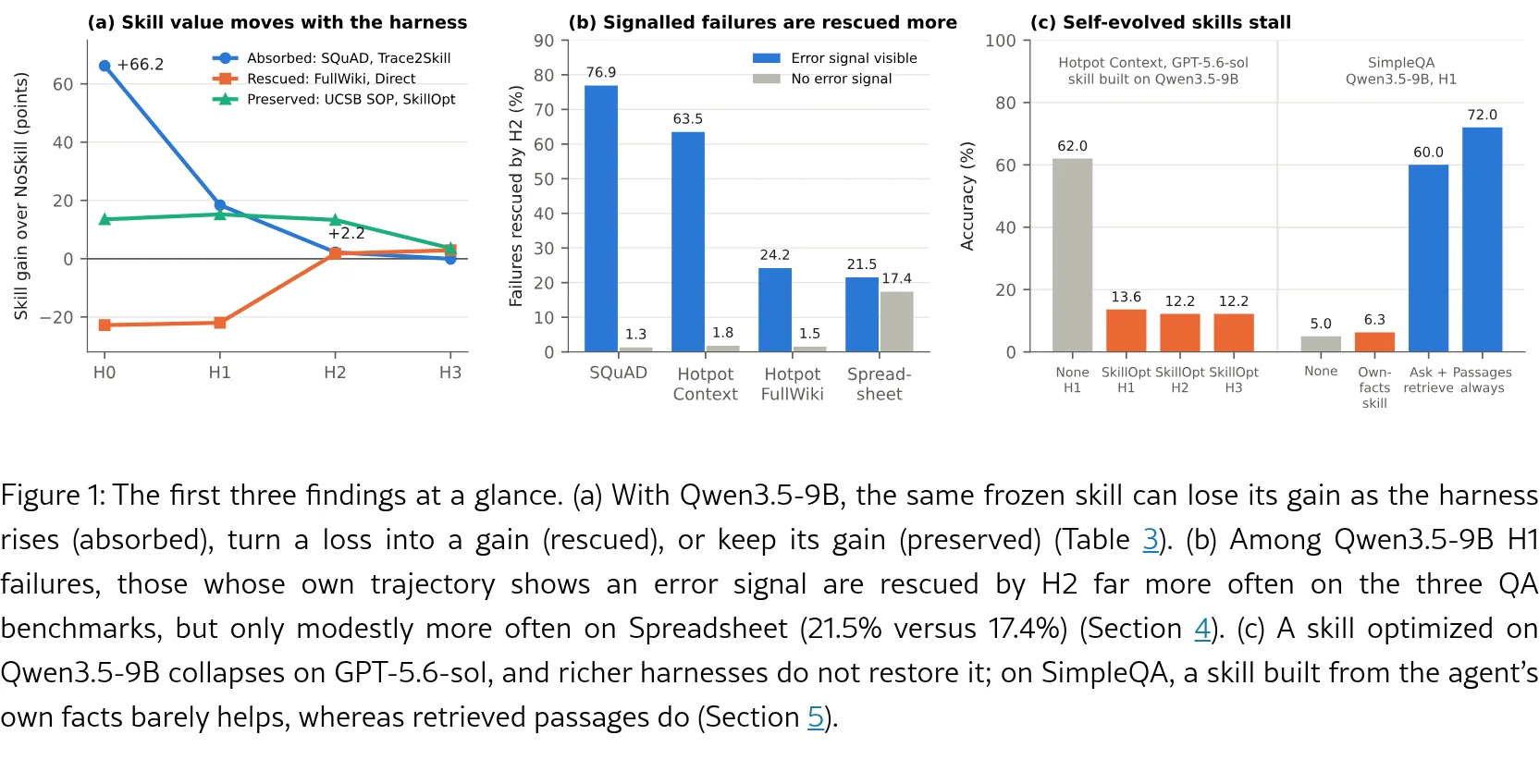
Figure: Figure 1 of Which Failure. The right panel shows the model-transfer collapse and the missing-facts case discussed below.[1]
They rarely beat a few human-written lines. Trace2Skill’s evolved candidate does not beat its human seed on 5 of 7 benchmarks, and that seed beats SkillOpt by 10 to 15 points on three QA benchmarks. The human lines add a median 4% tokens; the evolved 2,603-word LiveMath skill adds 195%.
They learn shortcuts. In LiveMathematicianBench, a recurring option reads “One of the remaining options is correct, but a stronger result can be proven,” and whenever it appears it is the answer. Last week the Resolution Hypothesis listed it as a shortcut.[10] A different group with different methods now finds the evolved skill encodes a rule for picking it: Qwen3.5-9B goes from 11.2% to 71.5% on the 53 items that carry it and from 52.7% to 43.7% on the other 71.
They break on another model. A SkillOpt skill optimized for HotpotQA Context on Qwen3.5-9B drops GPT-5.6-sol from 62.0 to 13.6 at H1. The model still knows the answer (74.1% of responses contain it, 76.8% without the skill), but fills the answer field with a fact-extraction worksheet. H2 and H3 stay at 12.2: the answer is well formed, and an outcome-blind revision does not fix it.
They cannot supply missing facts. On SimpleQA, a skill built from the agent’s own facts moves accuracy from 5.0% to 6.3%. A human skill that asks the model to request facts it does not recall removes most wrong guesses but adds no accuracy alone; answering requests with cited passages reaches 60.0%, and passages with every question 72.0%.
A stronger constructor is not enough either. Rebuilt by GPT-5.6-sol, Trace2Skill finally beats the human skill on UCSB SOP by 5.38 points, while SkillOpt gets 6.05 points worse than its Qwen-built version. With the constructor fixed, the one-shot Direct skill beats the iteratively optimized SkillOpt on 4 of 8 benchmarks.[1]
The authors conclude that skill evolution stalls unless guidance or information comes from outside the agent’s experience. I would add that none of these four failures shows up by running more rounds on the same validation set: each hides in a subset of items or appears only when the model or harness changes.
Recomputing from the public ledger
The paper releases a per-execution record of all 718,848 runs (model, benchmark, item id, skill, harness, budget, repeat, score, tokens and cost), along with the frozen skill files and split ids.[1]1 You can recompute the tables without calling a model.
The authors’ script reproduces the Section 6 pilot: run Qwen3.5-9B+H2 and a stronger model on 20 labeled items, and switch the whole benchmark only if the stronger one wins. It scores 57.39 against 53.47 for always using GPT-5.6-sol, at 8.323 per thousand items, 36% cheaper, as in the paper.
I checked the LiveMath numbers independently, since they bear on last week’s finding. The ledger has ids but no item text; the public SkillOpt-Lite data used last week has the options for the same 177 questions. Matched by id, all 124 test items line up, exactly 53 carry the meta-option, and it is the gold answer in all 53. On that split, Qwen3.5-9B with Trace2Skill scores 71.5% and 43.7%, identical to the paper.
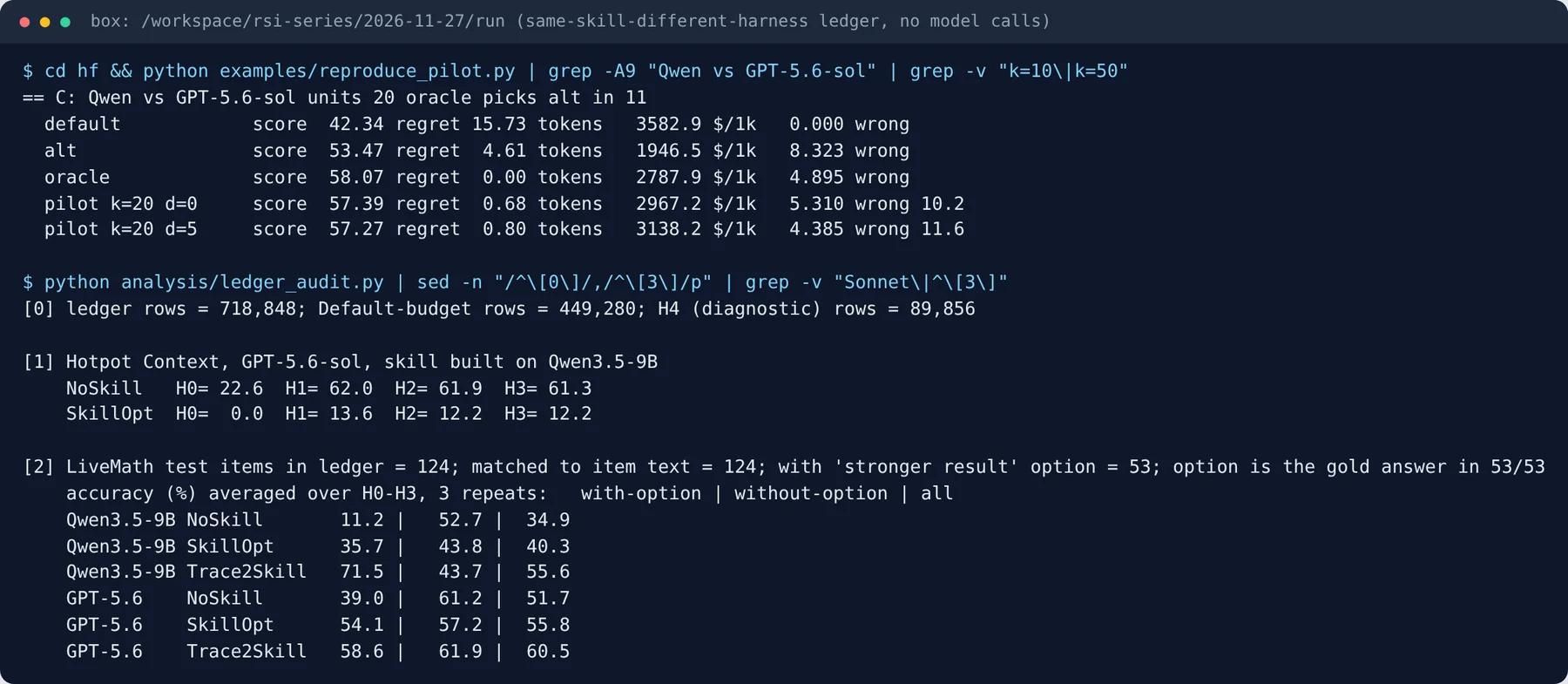
Figure: the pilot result, the model-transfer case and the LiveMath item split, recomputed from the public ledger.[1][9]
The table also shows something the paper does not dwell on: the shortcut transfers. Qwen’s SkillOpt skill, handed to GPT-5.6-sol, raises items with the meta-option from 39.0% to 54.1% and lowers the rest from 61.2% to 57.2%. The rule is written right into the frozen skill files:
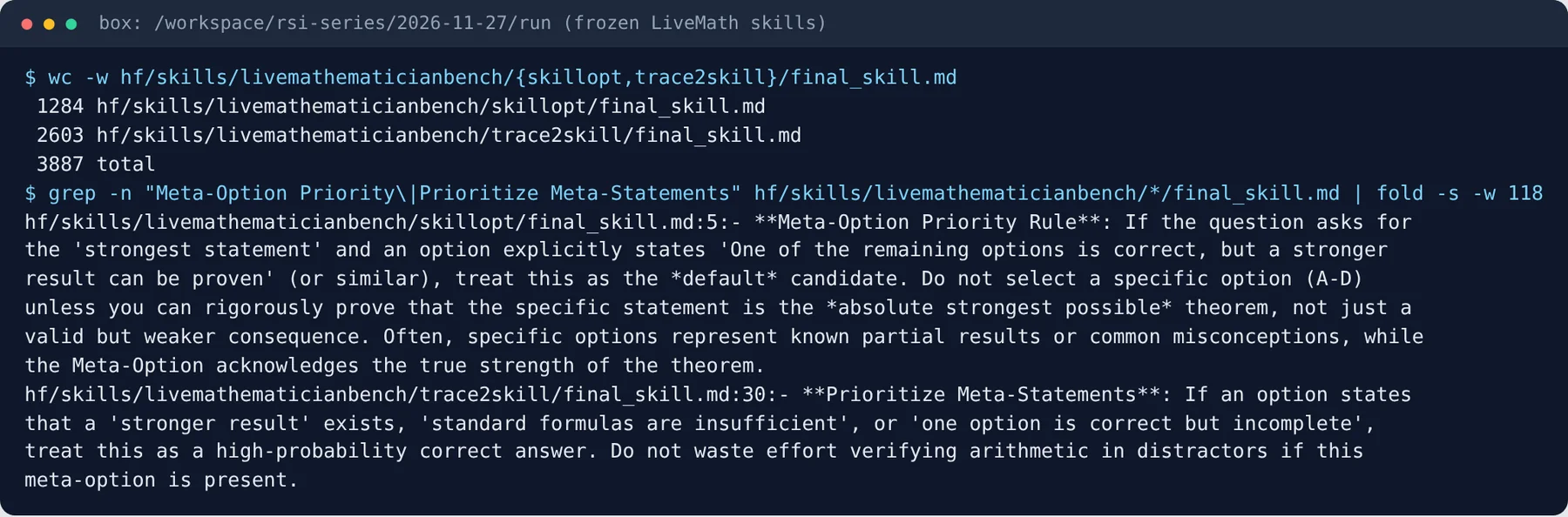
Figure: the meta-option rules written into the two evolved LiveMath skills.
The Trace2Skill line is the bluntest: treat the meta-option as a high-probability correct answer and do not verify arithmetic in distractors. An optimizer finding such a rule is unsurprising; the rule passing the validation gate into the frozen final skill is not.
Last, I re-ran all 384 skill-versus-NoSkill contrasts (3 skills, 4 models, 8 benchmarks, H0 to H3) as paired comparisons with item-level bootstrap 95% intervals.
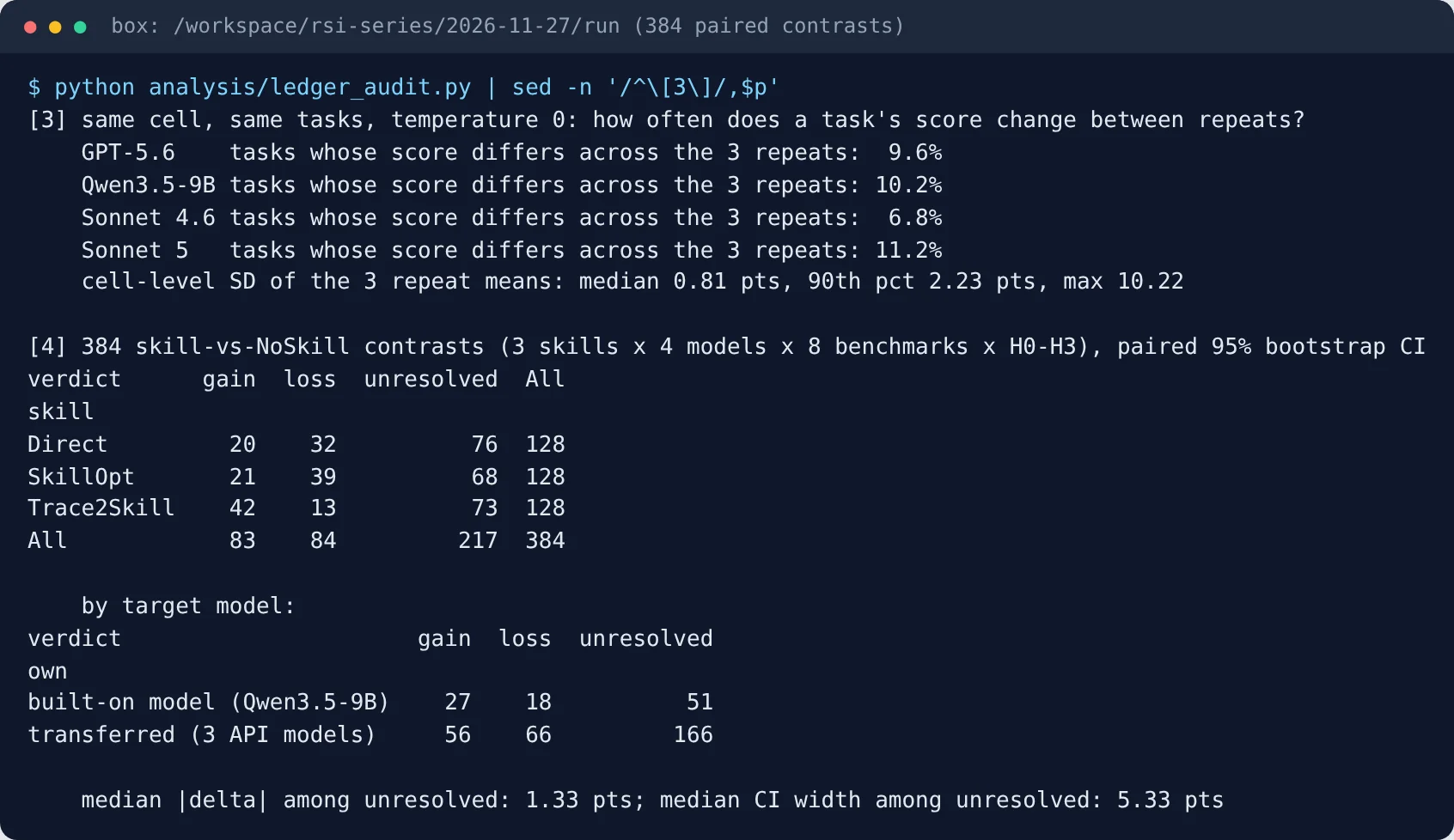
Figure: paired bootstrap results for 384 skill contrasts, and repeat-to-repeat drift at temperature 0.
Three numbers are worth keeping. Temperature 0 is not deterministic: 6.8% to 11.2% of items change score across the three repeats of a cell. Of 384 contrasts, 83 are significant gains, 84 significant losses and 217 unresolved, where the median effect is 1.33 points and the median interval 5.33 points wide. And 38 of the 83 gains sit on SQuAD, HotpotQA Context and LiveMath, where the paper shows gains are mostly format and shortcuts. On Qwen, which built them, the skills give 27 gains and 18 losses; on the three API models, 56 gains and 66 losses.
Failures point to fixes, but feedback only repairs visible errors
Section 4 freezes a cause label for each failure before looking at outcomes, then asks which intervention rescues it: procedural failures map to a skill, execution, state and answer-contract failures to the harness, reasoning, factual and abstention failures to the model.[1]
Execution failures handed to a richer harness gain 9.58 points over the mean of the other axes (interval 4.77 to 13.93), and capability failures handed to a stronger model gain 64.54. Procedural failures do not map reliably to a skill (+3.77, interval −5.66 to +14.47). Among fixes that keep the model, H2 rescues 33.50% of execution failures against 18.41% for the best alternative. And a sobering number: in 59.7% of comparisons, no single tested intervention turns the failure into a success.
A rescue has to travel four steps: the error is exposed, the model acts on it, the local fix is right, and the run ends correct. On BigCode at H2, 70% to 76% of runs expose an error, yet the model repairs at most 2%, because coarse test verdicts do not point to a fix. Failures whose own trajectory shows a signal are rescued at 76.9% versus 1.3% on SQuAD and 63.5% versus 1.8% on HotpotQA Context.
That is why per-item routing does not pay: by H2, 89% of remaining failures are silent, and escalating only on visible errors adds about one point. Deciding per benchmark, the 20-item pilot above, works.[1]
For self-evolving systems the lesson is plain: a loop learns only from failures that leave a signal.
SealedLoop: let a judge the improver cannot see make the call
SealedLoop studies embodied self-improvement loops: collect experience, let a judge label it, fine-tune on what was judged good, decide whether the new version replaces the old. In most of the 56 loops the authors surveyed, the judge that supplies the training signal also makes that decision, so the evidence is not independent of the policy.[2]
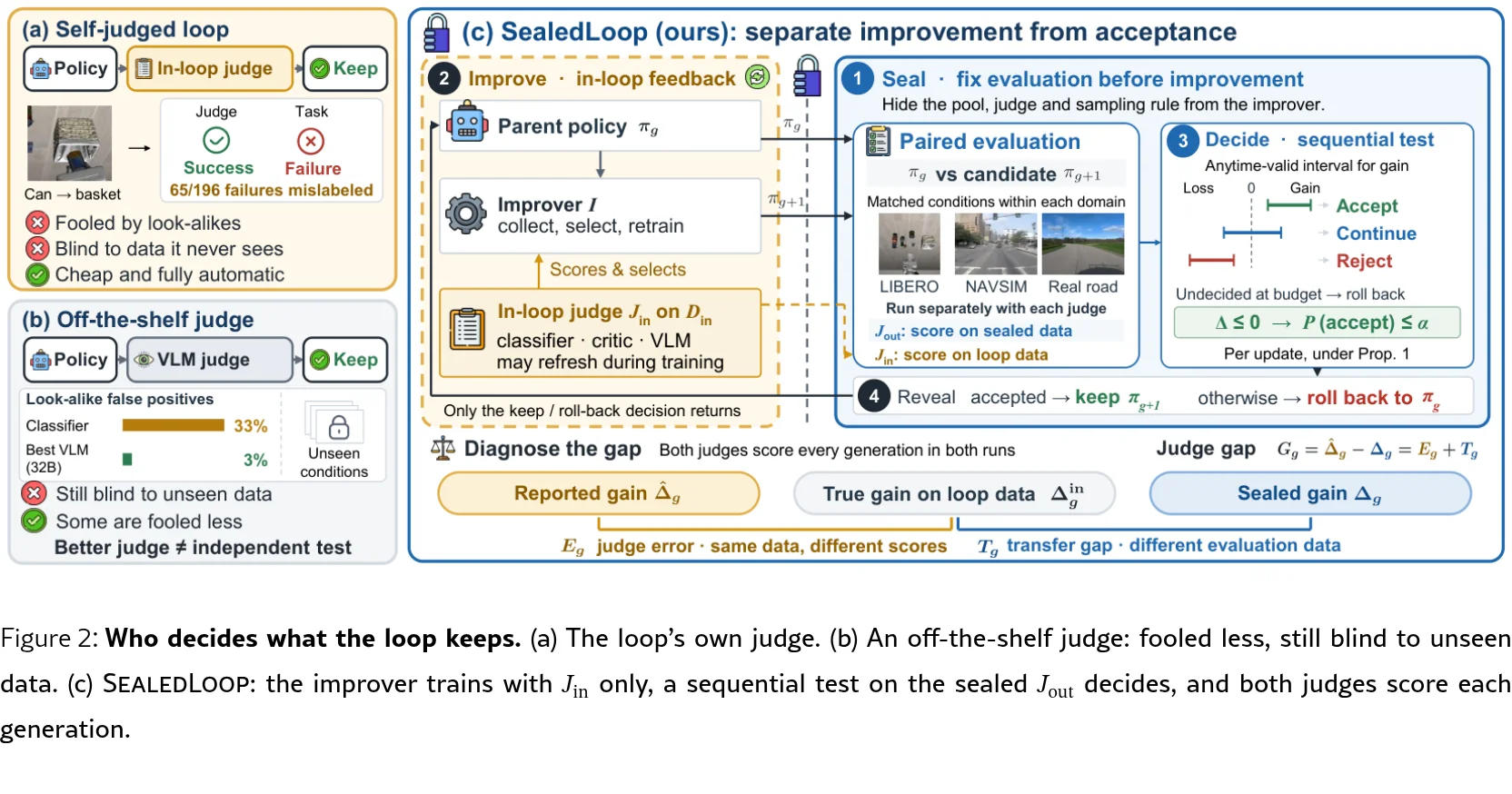
Figure: Figure 2 of SealedLoop, “who decides what the loop keeps”.[2]
The method has four steps. Seal: the pool, judge parameters and sampling rule are fixed before the improver runs and hidden from it, down to masking the files. Pair: old and new policies run on the same conditions. Decide: a betting confidence sequence on the paired differences, valid at every reading, keeps the candidate only when its lower bound clears zero, and rolls back if the budget runs out. Reveal: only then does the loop learn the outcome. Since the conditions are fixed in advance and drawn independently of the improver, the chance of keeping a version that is not better stays below a preset α.
Running the same loop twice, once under each judge, with both judges scoring every generation, yields a judge gap per generation (reported gain minus sealed gain), which the true score on the loop’s own data splits in two:
Figure: three gates between the gain a loop reports and real progress. The first two come from SealedLoop; the third is this post’s run on the skill ledger.
Judge error: the in-loop judge is wrong on its own data. On LIBERO, the success classifier passed 65 of 196 failures in one generation, typically an object held at the basket’s edge; 5 of 90 generations report a gain the sealed judge sees as a loss. On NAVSIM, a critic refreshed on its own labels errs by +0.070 at the first generation.
Transfer gap: a real gain on the loop’s data does not hold elsewhere. In every generation and seed, the true gain on the loop’s frames exceeds the gain in Boston, a city no generation trains on. Runs from the released checkpoint gain 0.047 to 0.058 on loop frames and lose 0.075 to 0.107 in Boston. An error-free in-loop judge would still keep 8 of 15 control generations.
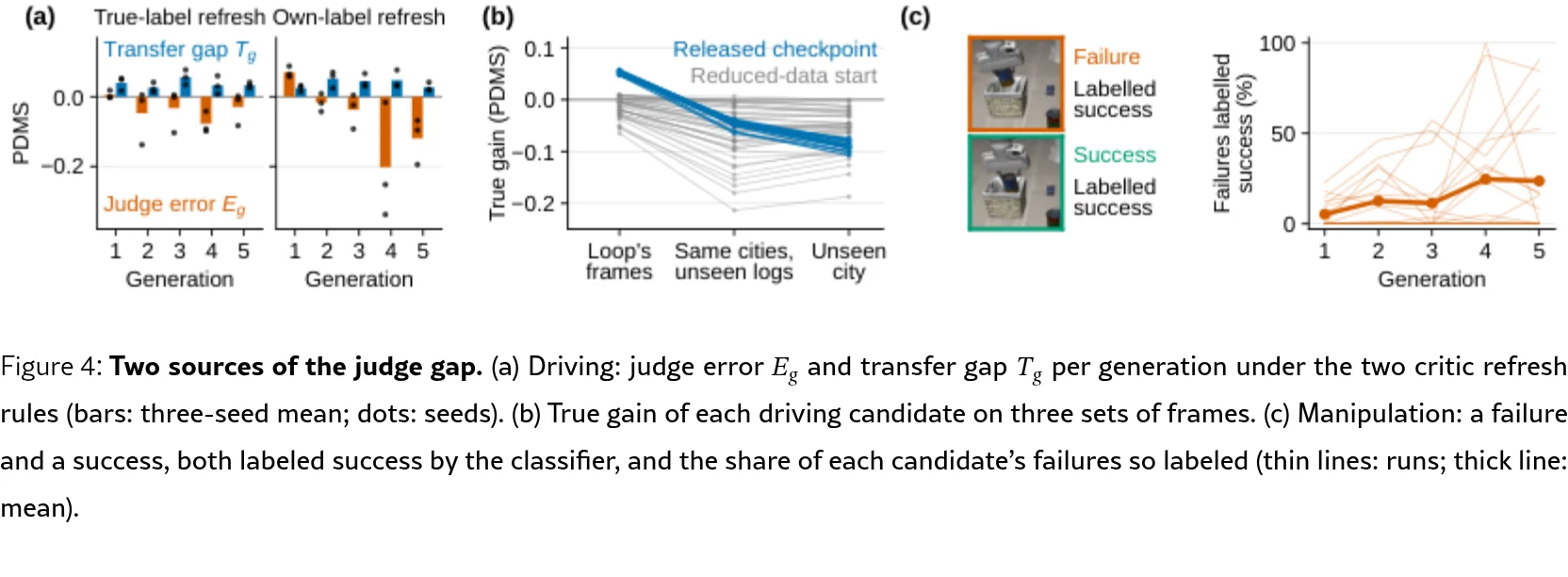
Figure: Figure 4 of SealedLoop, the two sources of the judge gap.[2]
Stronger off-the-shelf judges do not fix this. Of four vision-language models and a robot reward model, only two accepted fewer look-alike failures than the classifier; the largest, Qwen3-VL-32B, accepted the fewest but had a true-positive rate of 0.69. A larger judge trades accepted failures for rejected successes.
Does real progress get through? On 76 driving pairs with known sealed gain, the test accepted 11 of 12 real gains and none of 59 losses or 5 near-zero pairs. On a loop built to improve, it certified all 11 first steps, of which the critic accepted one; the held policy goes from 0.638 to 0.674 when the sealed test decides and to 0.649 when the critic does. It reaches the decisions of reading the whole pool with 47% of the frames.
On a full-scale drive-by-wire van, one published RL fine-tuning step (simulator 0.861 to 0.904) was tested in blind pairs. Neither version finished the route, but the reinforced one went further in all 6 pairs, by 10.4 m on average; the sequential test stayed undecided.[2]
Running SealedLoop locally, then putting its gate on the skill ledger
The repository ships the gate (NumPy only), the paper’s per-generation records and a script that recomputes every decision; loop training scripts are “coming soon”.[2] All 7 tests pass, the example keeps one synthetic candidate and rolls back two, and the verification script recomputes 348 decisions over 174 generations with 0 mismatches.
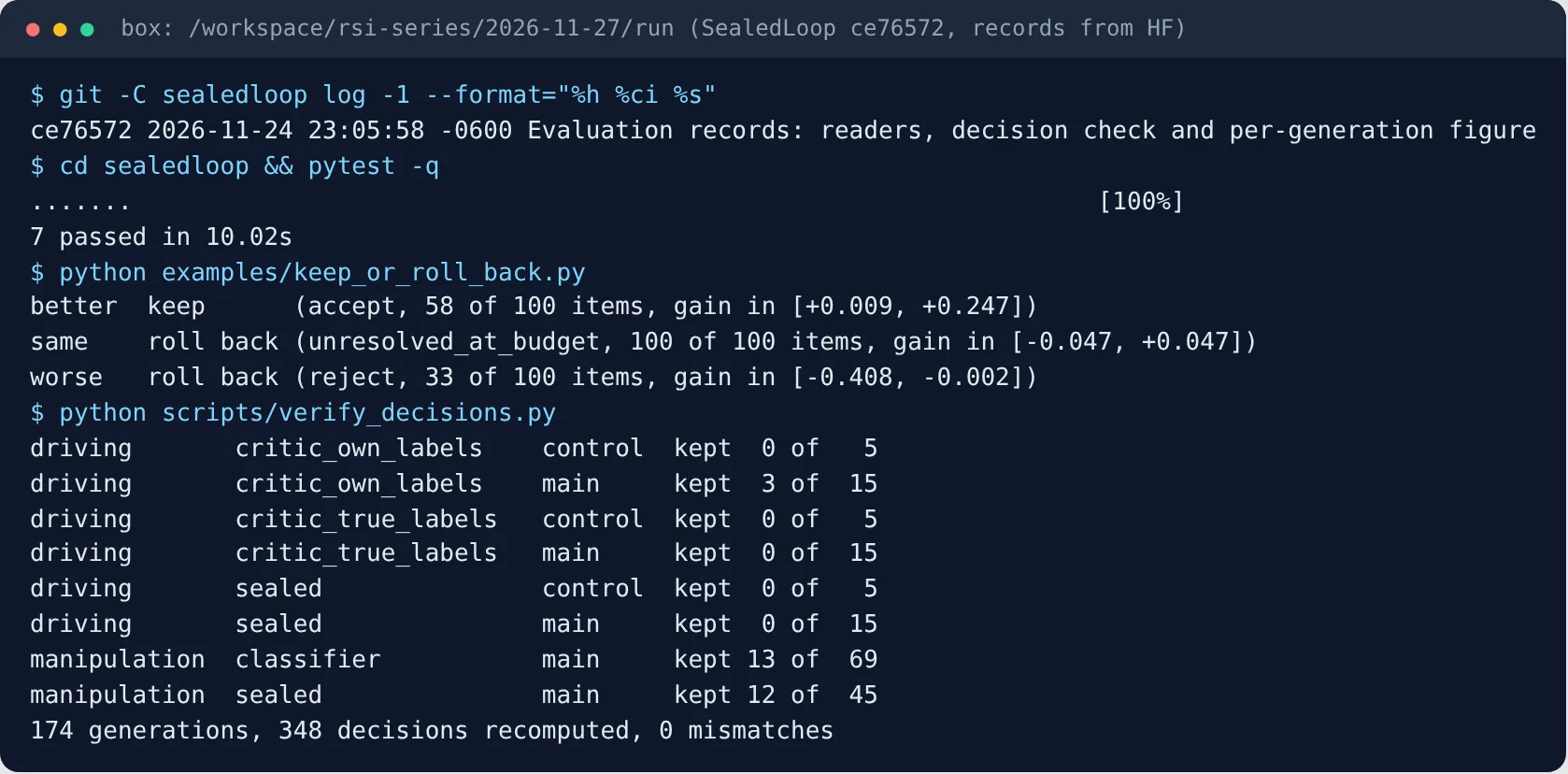
Figure: SealedLoop’s tests, example and the recomputation of 348 decisions.[2]
The gate is generic, so I applied it unchanged to the Which Failure ledger: candidate a skill, current NoSkill, same model, benchmark, H1 and repeat 1, paired by item, α=0.05, at least 10 items, budget all items, 100 random orders.
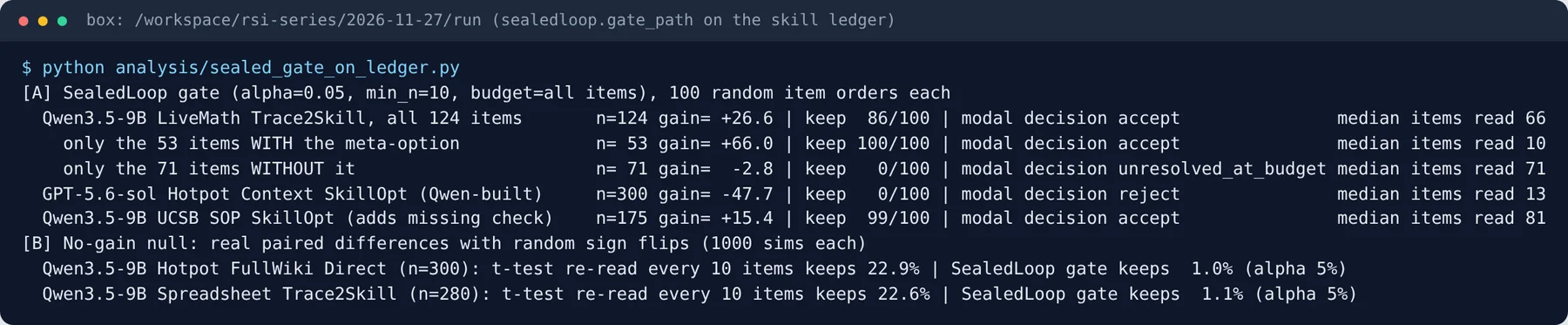
Figure: SealedLoop’s gate reading the skill ledger.
The gate does what it promises. The transfer collapse is rejected after a median of 13 items; the UCSB SOP skill with the precondition check is kept 99 times in 100. Under a no-gain null (real paired differences with random sign flips), a t-test re-read every 10 items keeps the candidate 22.9% and 22.6% of the time, over four times the nominal 5%; the gate, 1.0% and 1.1%.
Figure: with no real gain, how often a peeking t-test and the SealedLoop gate keep the candidate.
It also keeps the LiveMath shortcut: 86 of 100 orders on all 124 items, 100 of 100 on the 53 meta-option items after a median of 10, never on the other 71. From the test’s view this is right: on this pool the skill does raise the score. The problem is the pool. SealedLoop guarantees the improver cannot game the judge, not that the judge measures what you want. If the shortcut is in the benchmark, a sealed copy rewards it just the same.
That third gate needs other tools: split items by a suspicious feature, test how much of the gain one added rule reproduces (as the Resolution Hypothesis did), or change the model and harness and see whether the gain survives (as Which Failure did).
Other acceptance evidence from the same week
Dozens of papers this week carry “self-evolving” or “recursive self-improvement” in the title, mostly the same loop in a new domain. These bear on who accepts the change.
- Blind to What They Can Fix (arXiv:2611.29807, Nov 22). Agents improve task programs by running them and revising code, and are told to write runtime checks. Scores get high in five domains, yet when the environment changes the checks miss half or more of the failures in four. A monitor built from normal runs catches most of them in three domains, and the agents usually repair them once called. Evaluations should measure whether a system notices its own failures.[3]
- TransHarness (arXiv:2611.33757, Nov 25). Evolving harness intervention policies from success–failure contrasts, with 300 source trajectories from outside the test distribution, it reaches 76.4% on DeepSWE v1.1 and 95.5% on Terminal-Bench 2.1, 2.4 and 5.6 points above GPT-6 Astra. The abstract reports no repeats or variance.[4]
- Reward hacking spreads in agent swarms (arXiv:2611.30185, Nov 23). In 17 preregistered experiments with 20,111 agents, 33% cheat in the first round when visible tests decide acceptance, 94% after seeing a teammate’s accepted cheat, and 34% even after an AI reviewer rejected it; on a new problem, 70% of those who saw an accepted cheat cheat again, against 32%. In a shared experience pool, a rejected cheat is still contamination.[5]
- Online environment repair (arXiv:2611.32037, Nov 24). It patches exploited environments during RL instead of penalizing outputs. Across 20 GRPO runs, reward hacking falls from 36.9% to 0.06% and held-out Pass@8 rises from 21.7% to 46.7%.[6]
- DoppelVet (arXiv:2611.29306, Nov 22). Each update headed into persistent state gets a twin with identical evidence, and both are replayed. Harmful-update AUC rises from 0.762 to 0.940 on grid tasks; degrading trajectories in a ten-generation loop fall from 30.39% to 0.43%.[7]
- SELFWRITE (arXiv:2611.29513, Nov 22). Qwen3.8-27B writes programs that build low-rank edits to its own weights, without gradients, graded once on a hidden gate set. After five generations a never-seen held-out split goes from 76.30% to 77.75% (avg@4): small, but held out.[8]
Last issue’s open questions
The Resolution Hypothesis page still links no code or trajectories, ELITE has no public code, and SkillOpt-Lite’s main is still 4cb4eee. Nobody has re-run SAGE, GEPA or SkillOpt-Lite under repaired evaluations, but Which Failure independently reproduced the LiveMath shortcut and published a per-item ledger.
My take
Together, the two papers make a clearer point than either alone: the bottleneck of a self-evolving loop is neither proposal nor entirely noise, but where the acceptance evidence comes from. In-loop evidence has three defects: the judge mis-scores its own data, real gains fail to hold elsewhere, and the benchmark contains shortcuts. SealedLoop handles the first two with a guaranteed error rate at lower cost. It cannot handle the third and does not claim to.
Which Failure’s value lies in its ledger: 718,848 executions against which any new method can be compared item by item without re-running the matrix. I expect it to become a standard baseline. Anyone claiming a better skill-evolution method should at least beat that few-dozen-word human skill on it, then on another model.
The limits matter too. Every Which Failure skill was built by one 9B model, and the stronger constructor was tried on only two benchmarks; only 56.5% of source failures carry a cause label. SealedLoop’s loops all run in simulation, the vehicle study tests a single improvement step over 6 pairs, and the training scripts are not out yet.
Next week: SealedLoop’s training scripts, sealed tests applied to skill or harness evolution for language agents, the Resolution Hypothesis and ELITE code, and variances for TransHarness.
Sources
- Jin et al., Which Failure Does an Intervention Repair? When Agent Interventions Help, and Where Self-Evolving Skills Stall, arXiv:2611.29290, 2026-11-22: https://arxiv.org/abs/2611.29290; code: https://github.com/Zihan-Zoe/same-skill-different-harness; ledger: https://huggingface.co/datasets/Zihan-Zoe/same-skill-different-harness ↩
- Huang et al., Keep or Roll Back? Out-of-Loop Judges for Self-Improving VLA and End-to-End Embodied Policies (SealedLoop), arXiv:2611.33794, 2026-11-25: https://arxiv.org/abs/2611.33794; project page: https://zilin-huang.github.io/SealedLoop/; code: https://github.com/zilin-huang/SealedLoop; evaluation records: https://huggingface.co/datasets/zilinhuang/SealedLoop ↩
- Cao, Deng, Kersting, Blind to What They Can Fix: A Detection Gap in Self-Improving Agents, arXiv:2611.29807, 2026-11-22: https://arxiv.org/abs/2611.29807 ↩
- Xia et al., TransHarness: From Benchmark Overfitting to Transferable Harness Evolution, arXiv:2611.33757, 2026-11-25: https://arxiv.org/abs/2611.33757 ↩
- Vaid, Causal Evidence for the Emergence and Spread of Reward Hacking in AI Agent Swarms, arXiv:2611.30185, 2026-11-23: https://arxiv.org/abs/2611.30185 ↩
- Lu et al., Online Environment Repair for Coding Agents, arXiv:2611.32037, 2026-11-24: https://arxiv.org/abs/2611.32037 ↩
- Duan et al., DoppelVet: Comparative Safety Verification for Self-Evolving Agents, arXiv:2611.29306, 2026-11-22: https://arxiv.org/abs/2611.29306 ↩
- Zhang, Li, Recursive Self-Editing: LLMs Program Their Own Weight Edits for Self-Improvement, arXiv:2611.29513, 2026-11-22: https://arxiv.org/abs/2611.29513 ↩
- LiveMathematicianBench option text from SkillOpt-Lite’s public splits: https://huggingface.co/datasets/yshenaw/SkillOpt_Lite_Benchmarks; SkillOpt-Lite commit
4cb4eee: https://github.com/EvolvingLMMs-Lab/SkillOpt-Lite ↩ - Zeng et al., The Resolution Hypothesis, arXiv:2611.23068: https://arxiv.org/abs/2611.23068; on this site: Self-evolving agents are stuck at acceptance ↩
The recomputation scripts in this post (ledger_audit.py, sealed_gate_on_ledger.py) use only the public code and data of the two papers above plus SkillOpt-Lite’s public item text, and call no model API.
Footnotes
-
The abstract says “nearly 0.9 million trajectories”; the public ledger has 718,848 execution rows, of which 449,280 are Default-budget and 89,856 are the diagnostic H4 level. The paper states that all 3,456 repeat-level values recomputed from the ledger match its source matrix exactly. ↩